Page 1 of 1
Breaking a rear axle on a Model T
Posted: Sun Mar 22, 2026 5:25 pm
by bdtutton
Hello,
I hear stories of broken rear axles and I see floating rear hubs advertised to prevent this from happening. How often did this happen back in the day when roads were really bad? Also, our current roads are better, but the axles are over 100 years old, how often does this occur now? Is it caused by hitting big bumps or just being overloaded or is it just random chance?
.
I drive my 1914 Touring car pretty fast when I am alone, but go slow and easy when I have a car full of passengers. I have always been a little worried about breaking a wooden wheel when fully loaded.
.
Thanks...
Re: Breaking a rear axle on a Model T
Posted: Sun Mar 22, 2026 5:33 pm
by RajoRacer
Are your axles original or have they been replaced with modern replacements ? I have mint original Ford axles in my Racer that I built over 30 years ago and installed McEachern safety hubs 20 years ago !
Re: Breaking a rear axle on a Model T
Posted: Sun Mar 22, 2026 6:11 pm
by Allan
First, safety hubs do not prevent broken axles. Depending on how they are installed they may prevent the wheel/axle from departing from the car, allowing a safe stop.
I have only ever broken one axle in almost 60 years of T driving, so it is a rare occurence in my experience. That one axle broke at traffic lights when i went to take off. A gentle click was all I heard and the car failed to proceed!
Allan from down under.
Re: Breaking a rear axle on a Model T
Posted: Sun Mar 22, 2026 7:09 pm
by RajoRacer
Agreed Allan - my only concern was dropping my Ruckstell on the ground at speed !
Re: Breaking a rear axle on a Model T
Posted: Sun Mar 22, 2026 7:31 pm
by speedytinc
In 45 years I have not broken an axle. I dont recall anyone in our club breaking an axle ever.
I did see a fellow break an axle on a national tour. (one of many that typically have 80-100 participants.)
That break occurred @ the edge of a ball bearing conversion. Clean shear right @ the bearing edge.(Stay with original Hyatt rollers.)
I have seen a break from an inner seal with steel fingers that scratched the axle.
All my rear end builds are/were with excellent FORD axles. I trust ford more than a repop part.
I conclude that such breaks are very uncommon/rare when looking @ the cumulative miles we all drive.
Breaking an axle is not a concern to me.
If you want to be worried about something, worry about modern drivers doing something reckless & stupid to hurt you.
you are much more likely to be hit by another driver.
Remember Steve Jelf.
Re: Breaking a rear axle on a Model T
Posted: Sun Mar 22, 2026 7:53 pm
by Erik Johnson
My father told me that in 1949, a rear axle broke on his 1927 Tudor and the wheel went down the street without the car.
He said instead of replacing the axle, he took a rear end off a junked 1927 and put it in his car. He said the replacement rear end was worn-out and growled every time he went around a corner.
Re: Breaking a rear axle on a Model T
Posted: Sun Mar 22, 2026 9:34 pm
by TrentB
The following is an excerpt from The Reminiscences of Mr. John Wandersee:
All during this period from 1908, when vanadium had been perfected in the heat treat process to be used in the Model T car, we were experimenting constantiy on metals. On a lot of parts, like axle shafts, we got much better service and life on the manganese carbon steel properly heat treated than you could get out of a fancy alloy steel. For instance, when we were using chrome vanadium steel
for the rear axle of the Model T car, after we had about 10,000,000 cars on the road, you could drive from here downtown any day you wanted to and see two or three rear wheels laying on the pavement.
We had to stop that. We couldn't redesign the Model T car but we had to stop that. We cut out the chrome vanadium。It wasn’t so much cutting out the chrome vanadium, it was going to a different heat treat. We devised by proper analysis manganese carbon steel and then heat treated it to give us the desired results. We dried up everything. We dried up our rear axle trouble and our crankshaft trouble. We had a lot of crankshaft breakage. We substituted manganese carbon there too, properly heat treated.
- The Reminiscences of Mr. John Wandersee, page 47.
Ford designated carbon manganese steel as type EE steel. Vanadium steel was designated as AA or AAX steel. According to the drawing for the rear axle shaft, shafts made from EE steel were identified by stamping the name “Ford” in script in the keyway of the axle.
Re: Breaking a rear axle on a Model T
Posted: Sun Mar 22, 2026 9:57 pm
by ThreePedalTapDancer
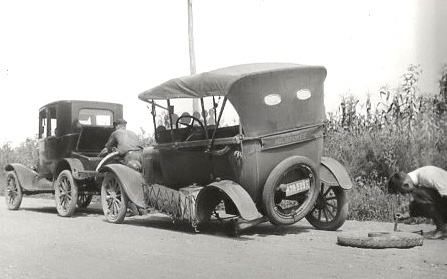
It must have happened regularly back in the day, enough so they would make an emergency tool for the occasion.
Re: Breaking a rear axle on a Model T
Posted: Sun Mar 22, 2026 11:44 pm
by Allan
That's interesting Trent.
I have a number of axles with the Ford script in the keyway, but I was not aware of the significance. In mining stuff from my stash at the farm, my spares could have come from any rear axle assembly, but while i do have Ford axles so stamped, I do not have many big brake drum housings.
Allan from down under.
Re: Breaking a rear axle on a Model T
Posted: Mon Mar 23, 2026 9:55 am
by Jerry VanOoteghem
My grandfather had a 1919 Touring car. My dad told the story of riding around with his father, on Belle Isle, (a park on the Detroit River), when suddenly a lone wheel passed them by. Grandpa laughed and said, "Ha! Some fool lost a wheel." It was at that moment that the rear end of Grandpa's car sunk to the ground and dragged to a stop. He somehow got a hold of one of those emergency axles, (shown above), and had the car towed home. This would have been in the 1920's.
Re: Breaking a rear axle on a Model T
Posted: Mon Mar 23, 2026 11:22 am
by George House
I always thought the reason for breaking a rear axle was an axle castellated nut not too tight. Thereby allowing the hub key to wallow around and finally breaking a chunk out of the tapered keyway. The more $ frugal among us would have a keyway machined 180* from the broken keyway. So I wouldn’t have thought that thick axle shaft would break. BTW, thank you Trent for the steel improvement info of machined components thru production.
Re: Breaking a rear axle on a Model T
Posted: Mon Mar 23, 2026 11:33 am
by NoelChico
I overhauled a Ruckstell that had been sitting on a rancher's hill for 70 years and replaced with new axles in 2004. The right axle broke while pulling from a stop sign on the Hamilton tour in 2024. My research showed a bad batch of axles produced prior to my replacement. It broke just inside of the Hyatte bearing. Of interest, the keyway was only cut 0.110" deep.
https://www.mtfca.com/discus/messages/2 ... 1191554745
Re: Breaking a rear axle on a Model T
Posted: Mon Mar 23, 2026 2:04 pm
by Rich P. Bingham
TrentB wrote: ↑Sun Mar 22, 2026 9:34 pm
The following is an excerpt from The Reminiscences of Mr. John Wandersee:
All during this period from 1908 . . . after we had about 10,000,000 cars on the road, you could drive from here downtown any day you wanted to and see two or three rear wheels laying on the pavement . . .
Surely that transcript is incorrect ? Ten million cars on the road represents 2/3 of all Model T production, with rear wheels falling off at an alarming rate ? (Maybe after 10,000 cars ? “. . . period from 1908 . . Z)
And, is there any significance to the “X” after the Ford script in the photo ?
Excellent, informative post !! Thank you, Trent !!
Re: Breaking a rear axle on a Model T
Posted: Mon Mar 23, 2026 2:58 pm
by Scott_Conger
That Wandersee posting above is only 1/2 the story regarding axle breakage...it is followed by:
"...We cut out the vanadium. It wasn't so much cutting out the chrome vanadium as it was going to a different heat treat. We devised by proper analysis manganese carbon steel and then heat treated it to give us the designed results. We just dried up everything. We dried up our rear axle trouble and our crankshaft trouble. We had a lot of crankshaft breakage. We substituted manganese carbon there too, properly heat treated.
The manganese carbon steel that Wandersee refers to is Ford Type EE steel. Most of you already know that the EE steel crankshafts were the best Model T crankshafts Ford ever made, and are highly sought after today."
So, the rest of the story regarding 10,000,000 cars on the road and seeing wheels in the ditch are all Model T recollections of trouble which was finally rectified late in production with the introduction of EE Steel.
Re: Breaking a rear axle on a Model T
Posted: Mon Mar 23, 2026 3:35 pm
by Rich P. Bingham
Thanks for clarifying that, Scott. I guess the “improved cars” really
were improved, then !

Re: Breaking a rear axle on a Model T
Posted: Mon Mar 23, 2026 4:28 pm
by DanTreace
Interesting on breaking Ford axles back in the day. Had posted the below pic of axle dimensions some time ago, obtained it from this article from 1920 issue of Automobile Dealer and Repairer, May 1, 1920, "Special Ford Number" as this issue has lots of Ford info.
Here is the rest of the story on garage shops making Ford axles for customers who have busted axle like this sad fellow 
- 859990.jpg (44.63 KiB) Viewed 152 times
Note the need for repair men to get a share of those 10,000,000 Fords that give way in the rear 
Re: Breaking a rear axle on a Model T
Posted: Mon Mar 23, 2026 5:57 pm
by George Mills
As Wandersee went on to say in other remembrances, the magic of Vanadium Steel started to be phased out starting just before Rouge was built. Whether they did so by design, or by what they were planning on doing...because it was around 1921 that the SAE grades of steels came out and for the most part not much of the Ford material science made it to the big book that followed. The Ford Institute still carried the old Ford grades even through the 1935 update, how much they used of old grades is unknown. (on another subject, I have found actual drawing evidence of an approved substitution for Z-bronze. Ford allowed substituting #6 Bronze but heaven forbid I should find out what that was...dare I guess what became SAE 60? I dare not as my own experiments show not the same)
Just a little wonky story to share with people that might appreciate one. Any axle regardless of composition used in bending will fail usually quickly if there is a scratch (from a bearing) or some other surface defect sure as really sharp keyway edge. Once it starts, the eventual break looks like a seashell until it snaps...if it snaps in a helix, it could be a scratch start as the weakest point...but torsion at the wheel is what took it out. The manganese and other chromium steels that followed had severe limitations in their own structural stress resistance in a rotating flexure mode so I'm getting ahead of the story.
I spent a good bit of my career developing high flexure chrome moly steel with some over the top heat treatment..I was eventually succesfull with a combination of chemistry, heat treatment to almost chrystaline then anneal back a few points. Best flexure steel ever produced...even has an SA number and well documented in ASME situations also, extremely expensive tho'. Typically used in a long standing application that has a .032 deflection in 100" that rotates at 500 rpm with expected service life in the range of billions on billions of revolution. The heat treating is induction, massive induction with a quench that would rival Niagra Falls, there is no sharp transition zone between the crust and the core following the anneal and the surface comes out at Rc 60-62 without brittleness. This takes care of the bearing load question as it is tough as tough can be...not scratches.
So once the process was almost ubiquitous and begun to be understood, I also discovered that steel mills in China had begun using Vanadium once again for certain grades so I was intrigued to put it mildly having been a T guy for decades...so I bought some V-steel, did the modern heat treat on it, and got it up to a consistent 160,000 psi output. Can't tell the failure rate as since adding V-steel to the arsenal for that product there have been zero failures now for 8 years. Just sayin...Vanadium had some value, Wandersee and Ford just couldn't convince the world and as Ford owned all the sourcing rights to vanadium steel that alone probably led to its own demise. I suspect that with the formation of SAE and what we call the number series grades that followed from the American Steel and Iron Institute, that Wandersee also saw a long awaited relief in his role as wizard for Ford, creating alloys that matched testing standards associated with what the designers thought (some Ford drawings for example stated, use 60,000 psi steel and it was up to Wandersee to come up with a formula to make it happen and get three the tensile testers. So went metallurgy as a science in the era...